Building automation · 12 min read · Updated November 2026
Building Automation (BMS) Consulting in Vietnam: Scope, the 2027 Energy Code and How to Choose a Partner
What an independent BMS consultant actually delivers, what Vietnam's new energy code QCVN 04-3:2026/BXD asks of building controls from 1 February 2027, why BACnet/SC belongs in new specifications, and a checklist for choosing a partner.
Short answer. A BMS consultant turns "we need a BMS" into something you can tender, test and hold a contractor to: an architecture, a points list, sequences of operation, network and cybersecurity rules, acceptance tests and, after handover, measured savings. In Vietnam the timing is pressing. On 1 February 2027, QCVN 04-3:2026/BXD replaces QCVN 09:2017/BXD as the energy code for buildings of 2,500 m² and above. It never says "BMS", but it does require energy metering over time, automatic capacity control for large chillers, pumps and fans, zone thermostats that hold ±1 °C, and automatic lighting and lift controls. A well-specified BMS is the simplest way to deliver all of that and prove it.
Updated 6 November 2026 · Tran Xuan Hoan, automation engineer · Checked against QCVN 04-3:2026/BXD (Ministry of Construction, July 2026), Law No. 77/2025/QH15, ANSI/ASHRAE Standard 135 (BACnet) and ISO 52120-1:2021.
Key points
- New code, firm date. From 1 February 2027, new and renovated offices, hotels, hospitals, schools, shopping centres and apartment buildings with 2,500 m² of floor area or more must meet QCVN 04-3:2026/BXD. Projects approved, or submitted for feasibility-study appraisal, before that date may stay on QCVN 09:2017/BXD.
- It regulates what a BMS does. Metering, plant capacity control, zone temperature control and automatic lighting and lift controls all appear as mandatory clauses.
- Large energy users have extra duties. Under the amended energy-efficiency law (Law No. 77/2025/QH15, in force since 1 January 2026), designated key energy users must apply an energy management model and keep an accurate metering system.
- Three clauses prevent most vendor lock-in: BTL-listed BACnet devices (BACnet/SC on new IP networks), a tagged points list, and owner-held passwords, licences and source files.
- Savings come from commissioning, not hardware. A US national laboratory study (PNNL, 2017) estimated that a full set of controls measures could cut commercial building energy use by about 29% on average. Untested sequences save little.
What a BMS consultant does, and what the contractor does
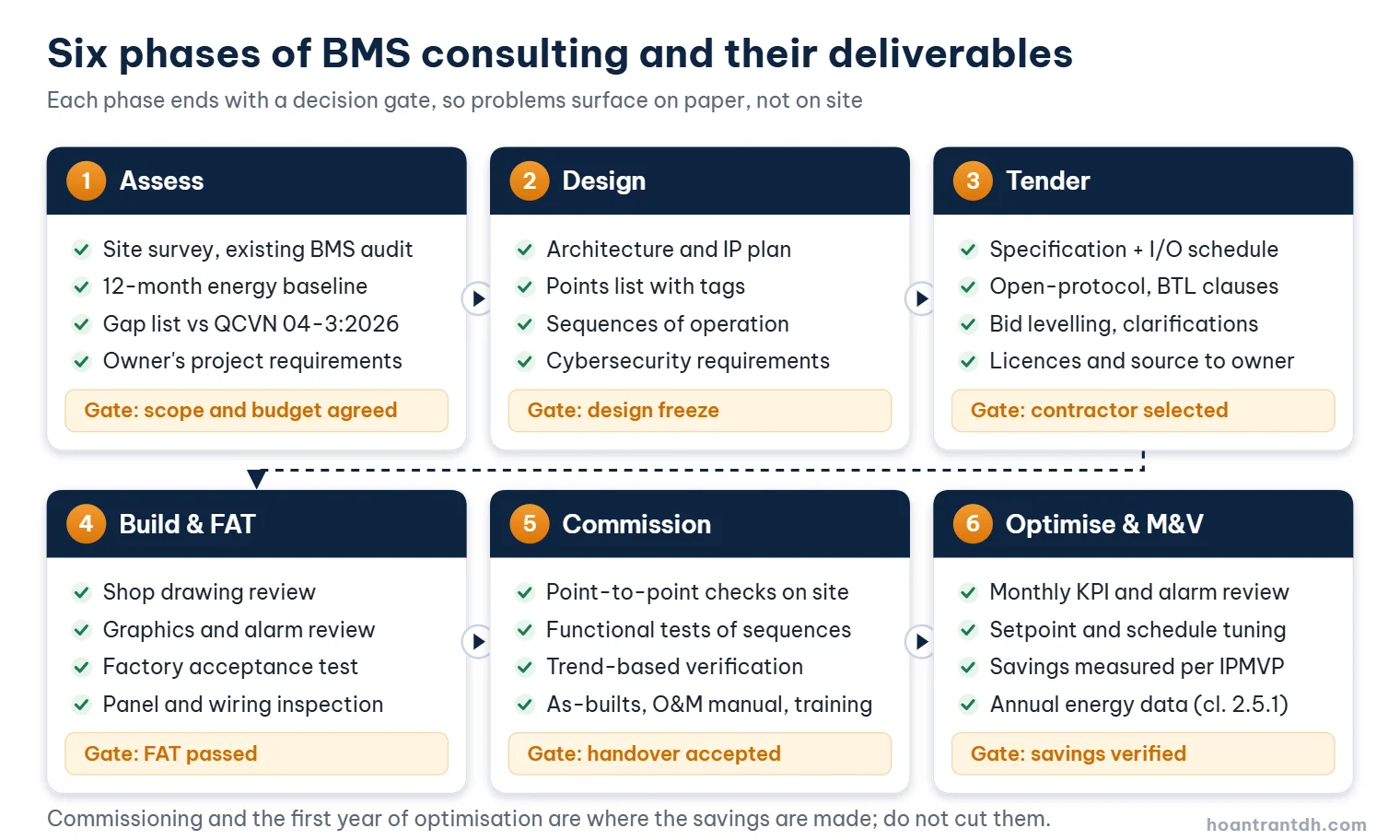
In Vietnam the BMS is usually a line item in the MEP contractor's package, and the controls vendor ends up designing it. That can work, but then nobody checks the design on the owner's behalf. The vendor writes a points list that suits its own controllers, the sequences of operation stay in the programmer's head, and testing happens without anyone independent watching. A consultant works for the owner. The split looks like this:
| Phase | Consultant (owner's side) | Contractor or controls vendor |
|---|---|---|
| Assess | Site survey, audit of any existing BMS, 12-month energy baseline, gap list against the energy code, owner's project requirements | — |
| Design | Architecture and IP plan, points list with naming and tags, sequences of operation, cybersecurity requirements | — |
| Tender | Specification and I/O schedule, open-protocol clauses, bid levelling and clarifications | Priced proposal, compliance statement, product data |
| Build | Reviews shop drawings, graphics and alarm lists; witnesses the factory acceptance test (FAT) | Panels, controllers, software, wiring, graphics |
| Commission | Witnesses point-to-point and functional tests; verifies with trend data | Runs the tests, as-built drawings, O&M manuals, training |
| Optimise | Monthly KPI and fault reviews, setpoint and schedule tuning, measurement and verification (M&V) | Warranty fixes, software updates |
The two most valuable documents are the points list (every sensor, command, setpoint and alarm, with a consistent name and unit) and the sequences of operation (exactly how each system should behave). With only these two, any competent integrator can bid against the same scope, and you can test what was delivered. For HVAC, ASHRAE Guideline 36 is a good starting point because it publishes standardised, high-performance sequences instead of leaving every project to reinvent them.
If you need a common yardstick for how much automation a building should have, ISO 52120-1:2021 grades building automation and control functions into four classes, from A (high energy performance) to D (not energy efficient). Writing a target class into the brief tells bidders what level of control you expect.
QCVN 04-3:2026/BXD: what Vietnam's 2027 energy code asks of controls
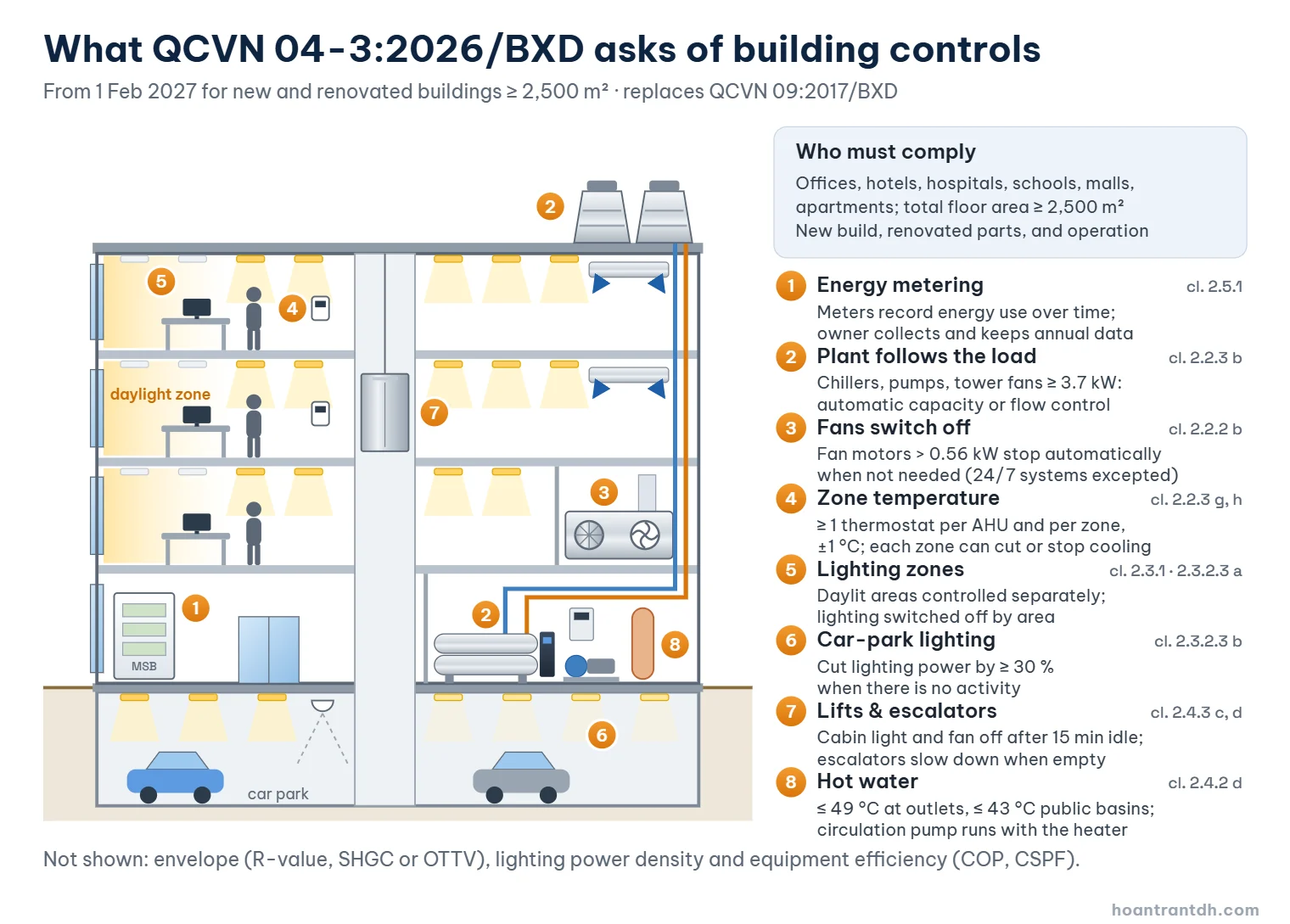
The Ministry of Construction issued QCVN 04-3:2026/BXD, Civil buildings – Part 3: Energy-efficient buildings, in July 2026. It takes effect on 1 February 2027 and replaces QCVN 09:2017/BXD. It covers the design, new construction and renovation of offices, hotels, hospitals, schools, shopping centres and apartment buildings, or mixed-use combinations of them, with a total floor area of 2,500 m² or more. In a renovation, the requirements apply to the parts being renovated, and the energy-performance section also applies once the building is in operation.
The code does not mandate a "BMS" by name. It mandates outcomes, and most of them are control functions:
| Requirement (summary) | Clause | How a BMS delivers and documents it |
|---|---|---|
| Meters record energy use over time; the owner or operator collects annual energy data, including the type of building control system and monthly and annual consumption | 2.5.1 | Integrate main and sub-meters (Modbus, M-Bus), store trends, produce monthly and annual reports automatically |
| Chillers, hot-water generators, cooling-tower fans and pumps of 3.7 kW (5 hp) or more adjust capacity or flow automatically to match demand | 2.2.3 b | Plant sequencing, VSD speed control on differential pressure or temperature, trend logs as proof |
| Fan motors above 0.56 kW switch off automatically when not needed (systems designed to run continuously excepted) | 2.2.2 b | Time schedules, occupancy and status interlocks |
| At least one thermostat per AHU and per zone; room temperature held within ±1 °C in operation; each zone can reduce or shut off cooling | 2.2.3 g, h | Zone controllers, setback modes, trend-based check of the ±1 °C band |
| Offices, classrooms and reading rooms with daylight can adjust artificial lighting; lighting is switched by area, with daylit zones controlled separately | 2.3.1, 2.3.2.3 a | Lighting control system (often DALI-2) linked to BMS schedules and daylight sensors |
| Enclosed car parks reduce lighting power by at least 30% when there is no activity | 2.3.2.3 b | Occupancy sensors or a lighting controller, with status reported to the BMS |
| Lift cabin lights and fan switch off after 15 minutes idle; escalators slow down when unoccupied | 2.4.3 c, d | Built into the lift controller; the BMS monitors status and energy |
| Hot water no hotter than 49 °C at outlets (43 °C at public washbasins); circulation pumps run with the water heater | 2.4.2 d | Temperature control, pump interlock and alarms |
| Energy performance index determined under TCVN 13472:2022 after 12 months of full operation | 2.5.2 | Twelve months of clean, complete meter data |
The code also sets envelope limits (minimum R-values and maximum SHGC, or an OTTV alternative), lighting power limits and minimum equipment efficiencies. Those belong to the architect and the MEP designer, but operation is where they are proven, and that proof comes from BMS data.
What to do now: if your project will be appraised after 1 February 2027, write each clause above into the BMS specification as a testable requirement, with its own functional test and trend evidence in the commissioning plan.
Large buildings: duties under the amended energy-efficiency law
Law No. 77/2025/QH15 amended the Law on Economical and Efficient Use of Energy and has been in force since 1 January 2026. Provincial People's Committees publish the list of key energy-using establishments every year, and large buildings whose energy use exceeds the threshold set by decree can be on it. Designated establishments must apply the energy management model set by the Ministry of Industry and Trade, maintain an accurate metering system, prepare an energy balance, and submit annual and five-year plans and reports. Energy audits and certified energy managers are part of the same regime.
For a building owner the practical point is the same as with the code: energy data must be complete, trustworthy and easy to report. A BMS with integrated sub-metering turns that into a report you print, not a spreadsheet you rebuild every year. The law also defines energy service companies and energy performance contracts, which gives a legal basis for paying for a BMS upgrade out of verified savings.
Protocols in 2026: what to write into the specification
| Where | Protocol | Specification clause |
|---|---|---|
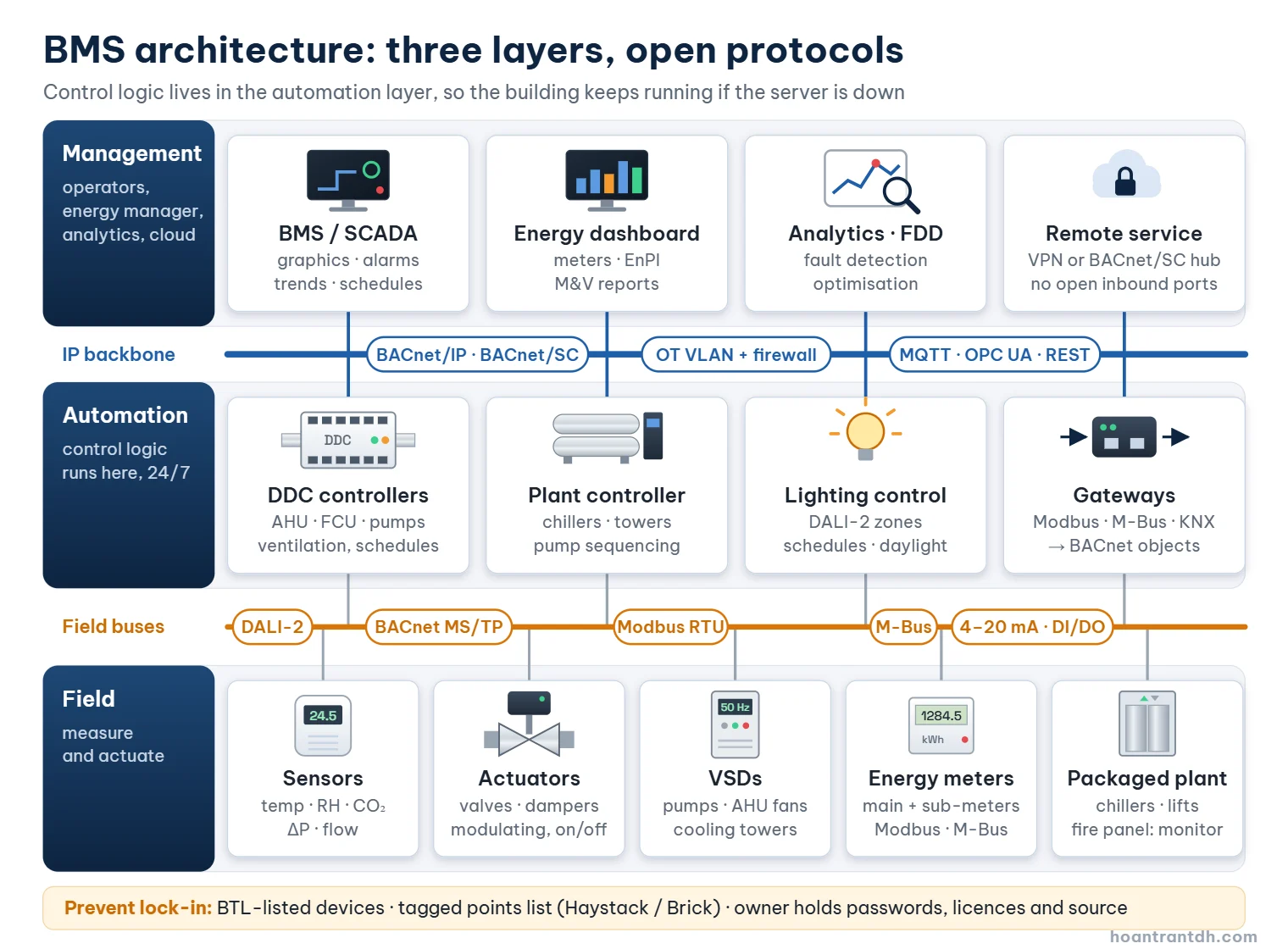
| HVAC controllers and head-end | BACnet (ASHRAE 135, also published as ISO 16484-5) | Devices BTL-listed for the stated device profile; object list and PICS in the submittal |
| IP backbone, new projects | BACnet/SC (Secure Connect) | SC-capable controllers or SC routers; certificate management included in the handover |
| Meters, VSDs, packaged chillers | Modbus RTU or Modbus TCP | Register map in the submittal, with scaling, units and word order stated |
| Lighting | DALI-2 | Certified devices; zones matching the lighting-control clauses |
| Hotel rooms, residential | KNX or BACnet room controllers | Integration list agreed at design stage |
| Analytics and cloud | MQTT, OPC UA, REST API | Read-only by default; writes only through the BMS |
Why BACnet/SC matters now. Classic BACnet/IP relies on UDP broadcasts and BBMDs, carries no encryption and is awkward to route through modern IT networks. BACnet Secure Connect, defined in Annex AB of ASHRAE 135, carries BACnet messages over TLS 1.3 WebSocket connections to a hub, with an X.509 certificate for every device. IT departments can treat it like any other encrypted traffic, and it needs no broadcasts. For a new IP backbone, ask for SC support across controllers, routers and the head-end. Where some devices are not ready, specify SC routers at the boundary and keep plain BACnet/IP inside a segmented VLAN.
Name things once. Analytics and fault-detection tools depend on consistent point names. Specify a naming convention and semantic tags (Project Haystack or Brick) in the points list. It costs little at design stage and saves weeks of mapping later. For moving data to IT systems, see OPC UA vs MQTT and Modbus gateways.
Cybersecurity is now part of the BMS scope
- Put the BMS in its own network zone (VLAN plus firewall), separate from office IT and guest Wi-Fi. The IEC 62443 zones-and-conduits model works for buildings as well as factories; see segmenting OT networks.
- No controller or BMS web page reachable from the internet. Remote service goes through a VPN with multi-factor authentication or through a BACnet/SC hub.
- Named user accounts, no shared or default passwords, and roles that separate viewing from changing setpoints and programs.
- Backups of controller programs and the BMS database, held by the owner and tested by restoring them.
- A patch and update policy written into the maintenance contract.
Typical findings in existing buildings
| Finding | Effect | First fix |
|---|---|---|
| Equipment left in manual ("hand") mode | Plant runs around the clock regardless of schedules | Restore auto mode; alarm and report every override |
| Chillers staged by the operator | Poor part-load efficiency, more machines running than needed | Automatic sequencing on load and supply temperature |
| VSDs running at fixed speed | Most of the value of the drive is lost | Control on differential pressure with setpoint reset |
| Drifting sensors (temperature, CO₂) | Wrong control decisions and comfort complaints | Calibration round; replace failed sensors |
| Trends disabled or not stored | Nothing to prove savings or find faults with | Trend key points at 5–15 minute intervals |
| No passwords or source files from the vendor | Owner locked to one supplier | Negotiate a handover; make it a clause in any upgrade |
How to choose a BMS consultant or integrator in Vietnam
- Independence. Ask who pays them and whether they receive commissions from any controls brand. A consultant should write a vendor-neutral specification.
- Real documents. Ask for an anonymised points list, sequence of operation and commissioning test sheet from a past project. Their quality tells you more than a reference list.
- Commissioning capability. They should test on site with trend data, not only review drawings.
- Protocol and security skills. BACnet with BTL listing, BACnet/SC, Modbus and network segmentation should be familiar ground.
- Bilingual documentation. Vietnamese for the operators who run the building, English for regional or foreign owners.
- Local support. Agree a response time for site visits, and remote support through a secure route.
- Measurement and verification. Savings should be measured against a baseline using IPMVP, not estimated.
- A clean handover. The owner receives all passwords, licences, programs, the database and the graphics.
Projects in Laos and Cambodia
The technical approach is the same: open protocols, a tagged points list, tested sequences and measured savings. Building codes and approval routes differ by country, so the QCVN sections above apply to Vietnam only; confirm local requirements with the project's local design consultant. When engineering support sits in another country, the remote-access design and the spare-parts plan matter even more, so settle both at design stage.
FAQ
Is a BMS mandatory in Vietnam?
QCVN 04-3:2026/BXD does not require a "BMS" by name. It does require energy metering over time, automatic capacity control for large plant, zone temperature control and automatic lighting and lift controls. In a building of 2,500 m² or more, a BMS is the practical way to meet and document these. Fire alarm and smoke control fall under separate fire-safety rules, and the BMS normally only monitors them.
When does QCVN 04-3:2026/BXD apply to my project?
From 1 February 2027, to new and renovated offices, hotels, hospitals, schools, shopping centres and apartment buildings with 2,500 m² of total floor area or more. Projects approved, or submitted for feasibility-study appraisal, before that date may continue under QCVN 09:2017/BXD.
Should a new building use BACnet/IP or BACnet/SC?
Use BACnet/SC for a new IP backbone wherever the controllers and head-end support it, because it brings encryption and certificate-based device identity. BACnet/IP inside a segmented VLAN remains acceptable, and BACnet MS/TP is still fine for field-level controllers.
How much energy can a BMS save?
It depends on the starting point. PNNL estimated about 29% average savings for US commercial buildings with a full set of controls measures, but a poorly commissioned BMS can save almost nothing. Set a baseline before changing anything, then measure the result.
Can we upgrade an old BMS without replacing everything?
Usually, yes. Keep working field devices and wiring, replace the head-end, add gateways or new controllers system by system, and verify every point as it is migrated. Plan the change-over so the plant keeps running.
References
- QCVN 04-3:2026/BXD – National technical regulation on civil buildings, Part 3: Energy-efficient buildings (Ministry of Construction, July 2026; effective 1 February 2027)
- Law No. 77/2025/QH15 amending the Law on Economical and Efficient Use of Energy (effective 1 January 2026)
- ANSI/ASHRAE Standard 135 – BACnet, including Annex AB (BACnet Secure Connect); ISO 16484-5
- ISO 52120-1:2021 – Energy performance of buildings: contribution of building automation, controls and building management
- ASHRAE Guideline 36 – High-performance sequences of operation for HVAC systems
- IPMVP – International Performance Measurement and Verification Protocol (Efficiency Valuation Organization)
- IEC 62443 – Security for industrial automation and control systems
- PNNL (2017) – Impacts of Commercial Building Controls on Energy Savings and Peak Load Reduction
Related: Energy meters, Rogowski coils and Modbus · IIoT edge gateways · Engineering services