Energy · 9 min read · October 2026
Energy sub-metering with SENECA meters: CT or Rogowski, MID, and Modbus integration
Factories in Southeast Asia are being asked for energy data per line, per tenant and per shift, for cost allocation and for ESG reports. The cheapest reliable way to get it is a DIN-rail meter with Modbus on every feeder. This guide shows which SENECA meter fits which feeder and how to get the numbers into your system.
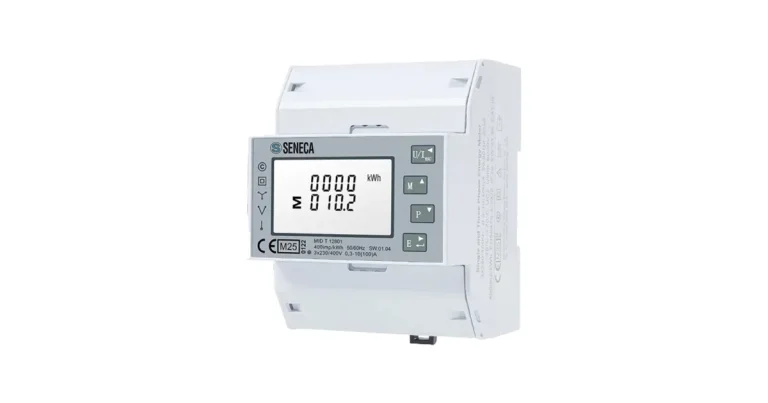
Three questions decide the meter: how will you measure the current, does the reading have to be legally valid for billing, and how will the data leave the panel. Everything else is detail.
1. Current transformer or Rogowski coil
| Current transformer (CT) | Rogowski coil | |
|---|---|---|
| Installation | Solid-core CT needs the conductor disconnected; split-core CT clips on but is bulky above 400 A | Flexible loop opens and closes around any busbar or cable bundle; no shutdown, fits in tight switchgear |
| Range | Fixed ratio, e.g. 400/5 A; saturates above its rating | One coil covers from a few amps to kiloamps; no saturation |
| Output | 1 A or 5 A secondary; dangerous open-circuit voltage if disconnected under load | Millivolt signal (RC150: 100 mV/kA at 50 Hz; RC160: 120 mV/kA at 60 Hz); safe to disconnect |
| Accuracy at low load | Falls off below about 10 % of rating | Linear down to low currents |
| Best for | New panels, incoming supply, where a CT is already fitted | Retrofits on live installations, large busbars, temporary audits |
SENECA's S604E-ROG kit ships the meter with three RC150 coils in 30, 45 or 70 cm length; the R204 pairs with RC160 coils in 30, 40 or 60 cm with 7, 11 or 17.5 cm internal diameter. For a 1,600 A incoming busbar you can fit the 60 cm coil in minutes during normal operation.
2. Which meter for which feeder
| Meter | Measurement | Interface | Use it for |
|---|---|---|---|
| S504C-6 | 3-phase 4-wire kWh counter via 1/5 A CTs; active energy Class 1 (EN 62053-21), MID version Class B (EN 50470-3); LCD; S0 pulse output 10,000 imp/kWh | RS-485 Modbus; M-Bus or Ethernet versions | Tenant and line sub-metering where the kWh figure must be defensible; 4 DIN modules per feeder |
| S604E | 3-phase power meter with backlit display: V, I, P, Q, S, energy, harmonics to the 15th; Class 1 active, Class 2 reactive; 8 MB log memory; CT (1/5 A) or direct 80 A versions | RS-485 Modbus RTU/ASCII; Ethernet models add Modbus TCP | Line monitoring where the operator also wants to see live values on the panel door |
| R204 | Power analyser with universal current input (CT 1/5 A, CT with mV output, Rogowski), up to 600 Vac, 0.2 % V/I and 0.5 % power, harmonics to the 55th and THD, 8 MB log, built-in web server; CAT III 600 V; UL | RS-485 Modbus RTU plus two Ethernet ports (daisy-chain) with Modbus TCP, MQTT, HTTP POST, FTP; variants for PROFINET, EtherNet/IP and OPC UA | Energy management systems, power-quality investigations, compressor and chiller plants, data centres |
3. What MID means and when you need it
MID is the European Measuring Instruments Directive. A MID-certified meter has been type-tested so that its kWh count can be used for invoicing between parties. If you charge a tenant in an industrial park for electricity, or allocate cost between joint-venture partners, specify the MID version of the S504C so that nobody can dispute the figure. For internal monitoring, line comparison and ESG reporting, the standard Class 1 meter is sufficient and cheaper. Local metrology rules in Thailand, Malaysia or the Philippines may require national approval for revenue metering; MID is the quality mark that makes that approval straightforward, but check with the utility regulator before using any sub-meter for billing.
4. Getting the kWh into SCADA, BMS or an EMS
- One RS-485 trunk per switchboard. Daisy-chain the meters, 120 Ω termination at both ends, unique Modbus address per meter, 9,600 or 19,200 bps.
- Bring the trunk onto Ethernet with a Z-KEY gateway, or use R204 meters whose own Ethernet ports daisy-chain between panels.
- Read the right registers. Energy counters are 32-bit values spread over two 16-bit registers; the manual gives the addresses and the word order. Read active energy import, export (for sites with solar), and the instantaneous power.
- Poll slowly. Energy changes slowly; a 10–60 s poll keeps the line quiet and still gives 15-minute demand profiles.
- Push, don't poll, from remote sites. The R204 publishes by MQTT or HTTP POST; a Z-LTE does the same for a panel without Ethernet.
HOANTRANTDH's Manufacturing Data Hub takes these readings and attaches them to lines, shifts and work orders, so an energy figure per tonne of product falls out of the data rather than out of a spreadsheet.
5. A sub-metering project in numbers
A food plant with one incoming feeder and twelve line feeders: one R204 with RC160 coils on the incomer, twelve S504C-6 meters with 400/5 A CTs in the MCC, one Z-KEY, one RS-485 trunk. Rail space: 48 DIN modules for the meters plus 17.5 mm for the gateway. Installation: one day for the CTs during a planned stop, one day for wiring and addressing, half a day for the SCADA tags.
Get a quote for this application
Send us the feeder list with current ratings, whether the panel can be switched off, and whether the figures are used for billing – we quote the meters, CTs or coils and the gateway.
Quick answers
Can I fit a meter without switching off the panel?
Yes, with Rogowski coils (S604E-ROG kit or R204 with RC160) and a voltage tap on an existing MCB. CTs normally need a shutdown.
Is the S504C bidirectional for solar sites?
Ask us for the version that counts import and export; the S534 in our Vietnamese range is the two-direction MID meter we most often supply for rooftop solar.
How many meters on one RS-485 line?
SENECA specifies up to 128 nodes for the R204's RS-485; in practice keep 20–30 meters per line and add a gateway per switchboard.
Which meter shows harmonics?
S604E to the 15th order, R204 to the 55th with THD, which is what you need when drives or UPS systems distort the supply.